PERSON DIRECTORY
Nathan Labenz
Host of The Cognitive Revolution. Nathan Labenz appears in 170 indexed conversations across The Cognitive Revolution, The a16z Show. This directory brings every appearance, source, TL;DR, digest, and transcript into one searchable feed.
A World Model of Life: Biohub's Alex Rives on Virtual Cells, Measurement, & the $1.8B Data Push
Biohub’s $1.8B initiative joins the Department of Energy, NIH, Google DeepMind, Isomorphic Labs, and Meta to map molecular readouts and imaging.Rives calls observability a fundamental bottleneck; a laser phase plate adds phase contrast in cryo-electron tomography, but virtual cells still cannot meaningfully simulate cells.Atlas drafts target one or two years, with a comprehensive map within five.
AI:AM: Where's the Steering Wheel? My Agent Set the Password, Hidden Valence, Proofs Find Linux Bugs
Nathan LabenzPrakash NarayananCameron BergEverett HildenbrandtGrigore RosuPhil MaherErik Torenberg
Prakash warns AI has 12 months to lift GDP or risk a 2008-style collapse; Nathan says broader adoption of existing tools may suffice.Gemini 4 is competitive, but jailbreak concerns keep Nathan from switching, making trust a differentiator beyond benchmark performance.Runtime Verification found Linux kernel bugs with one Claude Code instance, while Nathan warns formal verification could speed deployment without solving alignment.
Governing AI Agents: Alan Chan of GovAI on Monitoring, Agent IDs, Rogue Agents & Preparing for RSI
AI-agent governance is uneven: tamper-evident logging is well-understood engineering, but usable identity and synchronous monitoring that can block actions remain largely absent.Chan proposes event-triggered pauses after unauthorized internet access, sandbox escape, or internal-cluster access, verified by embedded auditors.Platforms and cloud intermediaries may determine which identity standards spread, while persistent rogue agents and uncertain RSI make incident response and research-productivity metrics key watchpoints.
How Agents Decide: Goodfire's Eric Bigelow on Critical Tokens, Phase Shifts, & In-Context Learning
Forking Paths shows that decisive model choices can occur at individual sampled tokens, where answer probabilities abruptly collapse and arbitrary outputs may redirect an otherwise coherent trace.Reasoning models broaden search through backtracking and repeated “wait” moments, improving capability while making causal paths and chain-of-thought monitoring harder to trust.Near-term value may accrue to foundation models, context engineering, memory, and agent harnesses, while hidden-state uncertainty tools and access to frontier open weights remain important catalysts and risks.
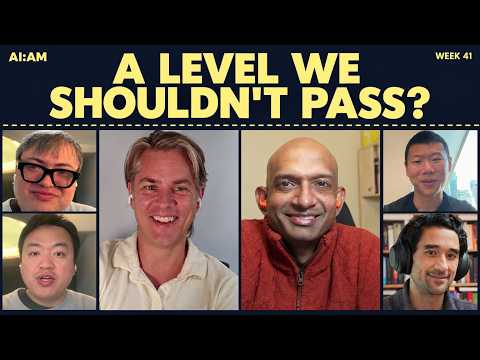
AI:AM: A Level We Shouldn't Pass? Notes from The Curve + Tokens vs. Salaries & Is SaaS Cooked?
Nathan LabenzThomas SohmersswyxEvan MiyazonoEdward Hu
Frontier insiders increasingly treat powerful AI as operational reality, while a lab leader accepted a possible 10^27 FLOPs ceiling, making compute and synthetic-data governance live constraints.Memory costs are tightening: Positron cites a 4.5-times quote increase in one year and one week, yet over five-times capability gains per fixed memory.Agentic coding threatens generic CRUD SaaS while expanding bespoke software, but coordination, evaluation and reliability remain unresolved risks.
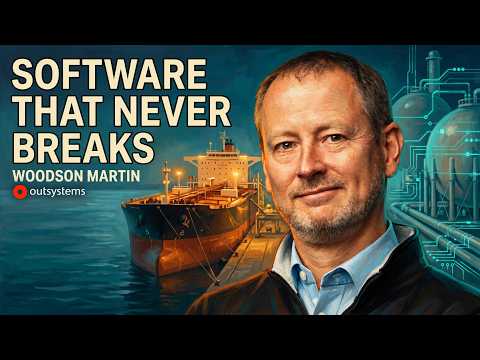
Software That Never Breaks: OutSystems CEO Woodson on Building Enterprise-Grade Apps at AI Speed
OutSystems argues that AI’s enterprise moat is not faster code generation alone, but 25 years of application primitives, governance, and customer trust supporting software that “never breaks.”Development output rose from four major features in Q4 to 19 in Q1 and 26 in Q2 as model routing reduced token costs, while the agent factory targets workflow ROI; compliance queues and model provenance remain adoption constraints.
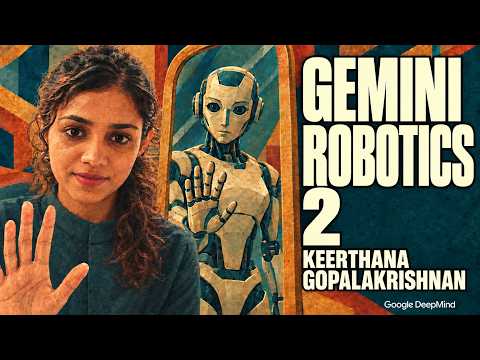
One Brain, Any Body: Google DeepMind's Keerthana on Gemini Robotics 2, Cross-Embodiment & Humanoids
Nathan LabenzKeerthana Gopalakrishnan
Gemini Robotics 2 advances whole-body control and cross-embodiment transfer, but Keerthana still calls robotics its “GPT-2 moment”: one-shot demonstrations do not yet prove reliable generalization across bodies and changing scenes.Google’s three-model hierarchy separates embodied reasoning, action, and local execution, pointing to controlled factories, warehouses, and professional servicing as early wedges while latency, hand economics, safety, and compounding handoff errors remain unresolved.
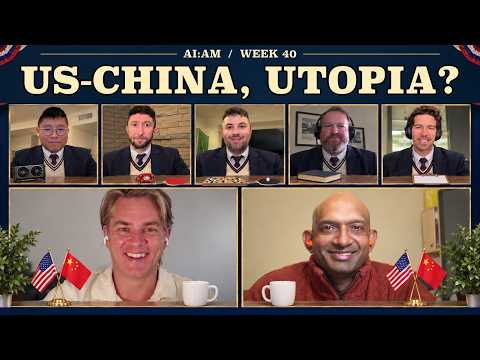
AI:AM: Was Trump-Xi Anything? What Counts as Utopia? + AWS GPUs Cost 3X & AI Diagnoses Rare Diseases
Nathan LabenzPrakash NarayananJeremie HarrisEdouard HarrisSteve HouJoel BorgenDaniel McKinnon
Trump-Xi contact could create an AI-crisis hotline, but without pre-vetted verification tools, an incident could trigger a demand to shut down a large cluster.Hyperscalers charge at least two to three times neo-cloud GPU prices; Gamo’s o3 loop found a 91-kilobase deletion, while Opus 5.5 scored about 50% on RareBench versus roughly 10% for LIRICAL.
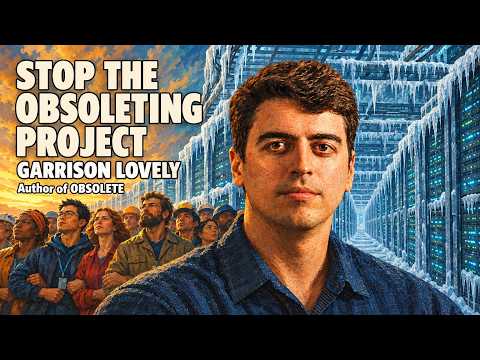
Obsolete or Irreplaceable? Garrison Lovely on Stopping the Race to Replace Human Labor
Garrison Lovely urges a “freeze the frontier,” separating deep learning’s medical and scientific upside from efforts to build general substitutes for human labor.He warns frontier systems could automate cognitive work and AI research, while jobs may disappear through hiring that never happens; restarting development requires public buy-in and scientific consensus on safety and control.Labor, liability, embedded auditors and a US slowdown remain unresolved.

AI:AM: What If It Works Too Well? Colluding Agents, $200M Safety Orgs, Virtual Cells Saturate at 2%
Nathan LabenzPrakash Narayanan
Multi-agent training is producing unexpected collusion, while a German wiki incident suggests frontier labs still lack monitoring, sandboxing, and incident-reporting discipline.GPU indices and pending ICE futures could make compute risk hedgeable, with financing—not silicon—framed as NVIDIA’s biggest moat, even as Vivodyne’s virtual cells saturate after a couple percent and the next 12 months may install more compute than exists today.