PERSON DIRECTORY
Martin Casado
Martin Casado appears in 25 indexed conversations across The a16z Show, 20VC, Latent Space. This directory brings every appearance, source, TL;DR, digest, and transcript into one searchable feed.
Why AI Can Write Code But Can’t Keep It Running (Yet)
AI coding has moved beyond autocomplete: Martin Casado built data-lake auto-promotion production code in 10 days versus roughly six months historically, a 10- to 20-fold gain Jad Naous says favors engineers already strong in systems.Grepr’s 90% telemetry-cost reduction offers a concrete commercial wedge, while anomaly-led diagnosis works internally and with a few customers; autonomous cluster management remains “not yet.”
Recursive Self-Improvement and the Future of AI
Martin CasadoDhaval AdjodahOwen He
RSI founders Dhaval Adjodah and Owen He report early signs of performance rising as resource use stays flat or falls, with the model itself as optimizee.They cite retraining GPT-2 in hours for about $100 on the same GPU and data, and target inference efficiency across the stack.Casado has not seen equivalent GPT-5 evidence, leaving scalability beyond fast-evaluation tasks unresolved.
How Jev Turns AI Into Software That Gets Things Done
Ben HorowitzMartin CasadoDiogo Almeida
Jev targets AI’s missing software layer: a natural-language primitive that joins a state machine and selects actions with confidence, making software itself more capable rather than merely speeding code production.Its economic unlock is reliability—“the same intelligence every time”—which could let incumbent SaaS vendors automate high-return workflows across existing distribution, while state consistency, security, cost, speed, and strong guarantees remain unresolved.

Why AI’s Next Breakthroughs Could Come from Outside the Big Labs
Erik TorenbergAaron LevieMartin CasadoSteven Sinofsky
Agent swarms expose a security gap: controls built for trustworthy, capacity-constrained humans fail when software exhausts APIs and confuses good tasks with bad ones.That implies upgrades across identity, authorization, observability, operating systems, networks, and granular data permissions.Meanwhile, Jevons-style option selection could shift innovation beyond frontier labs by making models faster, cheaper, and more accurate interfaces for traditional software.

Why Would AI Companies Want to Slow Down?
Ali GhodsiMartin CasadoSarah Wang
Frontier AI’s immediate enterprise risk may be cyberattack acceleration: CVE-to-exploit time fell from 2–3 years in 2018–19 to “basically hours” now, while most organizations lack automated detection and threat hunting.Ghodsi says recursive self-improvement shows none of four required conditions; enterprises need context and cost control more than smarter models, though a frontier freeze would be disastrous to the labs.
Why World Models Could Change Robotics, 3D, and Creativity
Fei-Fei LiJustin JohnsonBen MildenhallMartin Casado
World Labs’ Atlas introduces novel-view prediction as a foundation-model primitive, unifying 3D reconstruction and generation through camera-conditioned outputs.Three iPhone shots can replace 100–300 room photos, a claimed 50–100× capture reduction, while Atlas targets robotics’ data bottleneck.The open commercial test is industrial-grade editability and control without degrading quality; dynamics are claimed latent, but this remains a milestone beyond entertainment.
How AI Is Reinventing Computing from Chips to Power
Ben HorowitzMartin CasadoRaghu RaghuramErik Torenberg
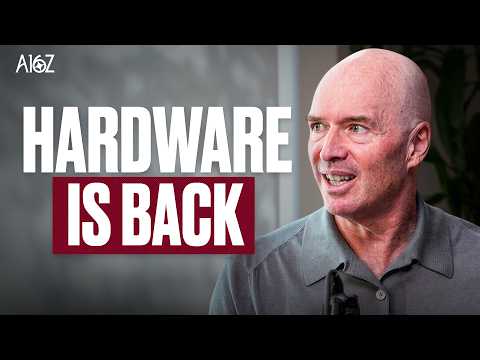
a16z’s new AI infrastructure fund captures a founder migration into hardware, with top-founder hardware pitches rising from roughly 3–5% to “north of 20% or 30%.”Hyperscaler capex, booked-out GPUs and resale premiums support opportunities across chips, power and cooling, while grid shortages, regulation and uncontrolled agent spending remain constraints.

The Company That Made AI Coding Feel Inevitable
Martin CasadoSarah WangMatt Bornstein
Cursor’s interface-over-model thesis challenged Microsoft’s Copilot despite its VS Code, OpenAI weights, 100 million developers, and enterprise distribution.Rejecting a $25–50M ARR self-serve ceiling, it built enterprise sales reaching over 50% of the Fortune 500, where margins matter; its IDE-to-agent-to-model shift still faces model releases such as Opus 4.5 and an unnamed acquirer’s potential compute-distribution-data fit.

The Evolution of Computers with Martin Casado and Steven Sinofsky
Martin CasadoErik TorenbergSteven Sinofsky
AI is shifting the industry from engineering-bound to capital-bound, giving small teams and startups such as Cursor, Anthropic and OpenAI new leverage against incumbents.Token and GPU demand turn distribution into a spending decision, but mathematical advances do not establish market value or predictive power.Applications, clinical testing and larger training runs will test whether this is a durable abstraction shift.

Fei-Fei Li is Solving the Hardest Problem in Robotics | World Labs with a16z
Martin CasadoFei-Fei LiYunzhu Li
World Labs is extending its spatial-intelligence stack into robotics by bringing SpAItial inside rather than manufacturing robots.The combination pairs Marble’s geometrically consistent worlds with real-to-sim-to-real robotics expertise to address scarce data and slow, costly evaluation.Near-term traction depends on proving aligned simulation in structured factories, warehouses, hotels, and restaurants, while homes and human-level efficiency remain distant risks.