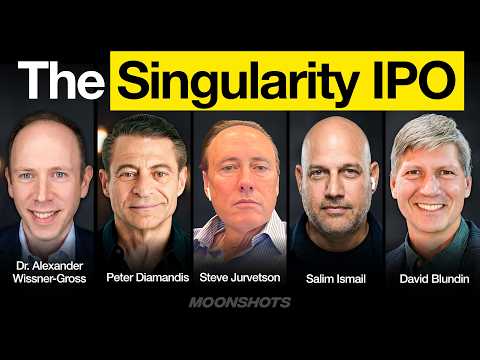
Steve Jurvetson: IPO-ing the Singularity, SpaceX Bet VCs Rejected, & Voyager’s 1 Light Day | EP #314
Peter DiamandisSalim IsmailDave BlundinAlexander Wissner-GrossSteve Jurvetson
SpaceX’s rejected DFJ investment was salvaged by anti-dilution and 2x return protections, not a lower price, converting partners who saw only 2–3x upside at a $450 million entry valuation.Jurvetson favors Google’s innovation trajectory over OpenAI, while Alexander ranks Google third today.SpaceX’s compute agreements, Terafab plans, and orbital ambitions point to a strategy of internalizing bottlenecks, with chip obsolescence and unproven demand remaining key risks.
Why Neo-Clouds are Great Businesses & The State of Compute with Kush Bavaria, Co-Founder @ Ornn
GPU scarcity challenges the assumption that compute will get cheaper, with CoreWeave availability stretching to Q4 2027 or Q1 2028.Kush Bavaria says Rubin at $20–$30 per GPU-hour would not surprise him, while older A100s and H100s may retain value for specialized inference.Those views depend on paying tenants, leaving demand and market consolidation as risks to monitor.
Anthropic Hits $2 Trillion in Historic IPO | Altimeter's Four Seasons of AI
Molly O'SheaEmmett ShearByron DeeterAlex HeathEthan BarajasNico RosbergAlex GardenJames DetweilerAidan GuoBrendan Foody
Shear argues that as reasoning becomes commoditized, genuine social alignment is the next frontier; training AI to perform care under observation may produce convincing actors rather than collaborators.Deeter’s AI 100 totals $3.6 trillion in valuation, versus $1 trillion for the Cloud 100 after a decade, as compute monetization expands the opportunity; whether inference providers become the next hyperscalers remains uncertain.
"It's so over?" Emmett Shear, Byron Deeter, Brendan Foody, Alex Heath, Nico Rosberg
Molly O'SheaEmmett ShearByron DeeterAlex HeathEthan BarajasNico RosbergAlex GardenJames DetweilerAidan GuoBrendan Foody
Deeter’s AI 100 averages $36 billion in valuation and 500% growth, though he sees turbulence and expects consolidation.Garden says Nemo can reduce verification costs to zero through mathematical and cryptographic proof; customers now test products reaching market.Heath relays an AWS CEO estimate that deployed inference is “not even 1%” of expected scale, while supplier winners remain uncertain.

Episode 204 - November 20, 2026
Graig SuvannavejhTim OplerBrian SkorneyChris GarabedianMatt Gline
Opler expects significant 2027 pharma M&A despite XBI losing 10 percentage points in three to four weeks, while Gline warns an AI bubble and 30–40% tech selloff could curb buyers.Overton’s withdrawal raises FDA uncertainty despite functioning reviews, while SELLAS’s $172 million raise at roughly a 30% discount shows financing needs can follow positive data.
20VC: Will Jensen Return to NVIDIA? Anthropic IPO and Mega-Rounds
Jensen’s possible return may not resolve China-linked chip-transshipment and export-control uncertainty or restore NVIDIA’s role as a venture exit backstop.Anthropic’s anticipated $1.4–$1.5 trillion IPO pairs a projected $100 billion revenue run rate with fewer than 6,000 employees, a ratio Rory doubts will generalize.Carta’s Q3 2026 data show deals down 21% as dollars rose 2.5x, while rapid fundraising could compress returns.
Solo GP: Most New VC Funds Are Built to Fail | Kevin Costa
Kevin Costa argues that $5–10 million funds writing $100,000 checks may return only 2–3X even with a winner, because limited ownership caps fund-level gains.Belief Capital’s $20 million fund requires 5–10% first checks; follow-ons prioritize hiring quality and shipping velocity over ARR, while operating help and introductions may improve information and access, but returns remain unproven.
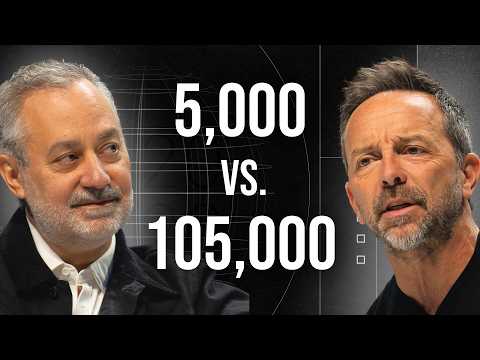
Brad Gerstner: Why Anthropic's IPO Is 10x Oversubscribed | TomorrowX Summit
Gerstner expects his fund’s biggest-ever IPO order, arguing Anthropic could reach $1 trillion in revenue by capturing about 4% of global knowledge work.He says compute costs are falling 90% annually and Anthropic is nearing a $100 billion revenue run rate with 5,000 employees; serving customers used about 500MW in the first nine months of 2026.That efficiency underpins his case for model leaders capturing most AI value, but he expects IPO volatility and would hedge part of his hedge fund exposure if Anthropic overshoots.
Dylan Patel, SemiAnalysis
Permits have pushed gigawatts of capacity from 2027 into 2028, while Patel sees no space-based relief for three or four years.Persistent agents now take 45% of his company’s $15 million annual AI spend, mostly via Perplexity Computer using Claude and OpenAI.Better harnesses can redirect usage, but Harvey’s fluctuating margins and uncertain Perplexity take leave durable economics unresolved.
Dylan Patel's SemiAnalysis Empire: $500M Fund, Citrini & NVIDIA?
SemiAnalysis shifted multiple gigawatts of data-center capacity from 2027 into 2028 as permits remain unavailable, while Patel expects space to add little capacity before “maybe 2030.”Patel says new very high-end chips will not be approved for China, and scrutiny could extend to GPU rentals; rental access may preserve demand while shifting business toward approved providers or AMD.Persistent agents rose to 45% of SemiAnalysis’s $50 million annual AI spend, mostly through Perplexity Computer using Claude and OpenAI, but margins and customer retention remain unresolved.