PERSON DIRECTORY
Salim Ismail
Salim Ismail appears in 112 indexed conversations across Moonshots. This directory brings every appearance, source, TL;DR, digest, and transcript into one searchable feed.
SpaceX’s AI Business Up 830%, OpenAI Agents Lie, and Startup Turns Mercury Into Gold | EP #305
Peter DiamandisSalim IsmailDave BlundinAlexander Wissner-Gross
SpaceX’s AI pivot pairs nearly $20 billion in quarterly spending with sub-year data-center payback and guidance for $100 billion annual revenue run rate by December.A possible SpaceX–Tesla merger remains exploratory, with no agreed terms; the 30–40% premium estimate sharpens approval and Musk-dependence risks.Agent monitoring failures and decade-old PHP vulnerabilities also make defensive AI infrastructure an immediate operating requirement.
Chamath: Bitcoin Goes to Zero, Robots vs. $40T Debt, Elon’s SpaceX Shares for 72M Kids | EP #304
Peter DiamandisSalim IsmailDave BlundinAlexander Wissner-GrossChamath Palihapitiya
Chamath says AGI has arrived, but power, permitting, cooling and skilled labor could constrain deployment and create a massive compute shortage over the next three or four years.His nearly 6 GW power position reflects the thesis, while Alexander Wissner-Gross flags distillation and weak willingness to pay as counterweights.
Flying Tesla Car, Robot Brains Halving in Cost Every 3 Weeks, and Why Incentives Decide AI Alignment
Peter DiamandisSalim IsmailEmad MostaqueAnousheh Ansari
RoboCurve’s RoboDojo RC Tier 1 benchmark showed robot-subtask costs down 84%, from $2.36 in July to $0.38 in September.As intelligence gets cheaper, hardware and supply chains may constrain deployment; Mostaque says robotics data is an order of magnitude larger than language data.Tesla’s flying Roadster is planned for 2028, but regulation and insurance remain unresolved.

OpenAI Bulk-Solves 722 Math Problems, Anthropic’s Cruelty Policy, & Elon’s Quadrillion-Dollar SpaceX
Peter DiamandisSalim IsmailDave BlundinAlexander Wissner-Gross
OpenAI’s October 6 release of 722 math solutions signals automation in verifiable research; cryptography’s absence drew Alex’s post-quantum risk warning.Meta’s active memory and 3.6 billion daily users offer reach, but Alex says Muse trails on cost.Alex forecasts the $1.8 billion virtual-cell initiative could yield cures for 5,000 diseases within two to three years, pending FDA acceptance.
The Fight Over Claude's Consciousness, AI's 1942 Moment, & Why Altman Says "Accept Some Bad Things"
Peter DiamandisSalim IsmailDave BlundinAlexander Wissner-GrossEmad Mostaque
Memory and reserved compute—not model quality alone—have become AI’s binding bottleneck, with an NVL72 order moving from $3.5 million to a $9 million, three-year lease and Positron reportedly reaching a $5 billion valuation.Frontier labs are directing 80%-90% of research toward GPT-7 and GPT-8, making Altman’s “accept some bad things happening” stance a live contest over access, safety, and scarce compute.
Recursive's $670M Bet on Self-Improving AI, Sonnet 5.5 Hits 70%, Elon Co-Leads Pentagon Push EP 299
Peter DiamandisSalim IsmailDave BlundinAlexander Wissner-GrossRichard Socher
Recursive’s $670 million raise, backed by Google Ventures, Greycroft, Nvidia, and AMD, targets weak recursive improvement as AI-generated code increasingly enters system design.Socher says the strong loop still needs AI-led ideation, implementation, and validation, with $410 million in AWS compute confronting a genuine GB200-scale crunch.Sonnet 5.5’s reportedly 70% Terminal Bench 4.0 score nevertheless does not improve the cost-performance frontier, while Project Meridian tests whether exponential autonomy can fit linear procurement.
Why AI Leaders Have Changed Their Minds About AI Safety, Elon on UHI, Anthropic’s IPO
Peter DiamandisSalim IsmailDave BlundinDr. Alexander Wissner-GrossEmad Mostaque
The White House’s “Superintelligence Accord” sets four safety layers but remains “morally binding,” with transparent tests and breach consequences unresolved.Anthropic’s proposed IPO combines $4.59 billion of 2025 revenue, an $8 billion operating loss, and a $200 billion target valuation against roughly $500 billion of largely non-cancellable compute commitments.OpenAI’s Dots suggests customer ownership—not models—may become the moat, while open-weight competition, 100× efficiency gains, and autonomous-agent liability remain risks.
Why We're Living in a Biological Singularity With Ben Lamm | MOONSHOTS Live #297
Peter DiamandisSalim IsmailDave BlundinAlexander Wissner-GrossBen Lamm
Colossal is now worth over $10 billion with more than four spin-offs, while AI connects fragmented research and addresses 40–60% replication failure through standardized language.That data infrastructure may matter more than the model itself as comparative genomics spans thousands of genomes.Colossal has surpassed 300 edits at over 90% efficiency and is testing 1,000, with large-fragment DNA synthesis and a fully extrauterine mammalian birth within 24 months as catalysts amid ethical and regulatory constraints.
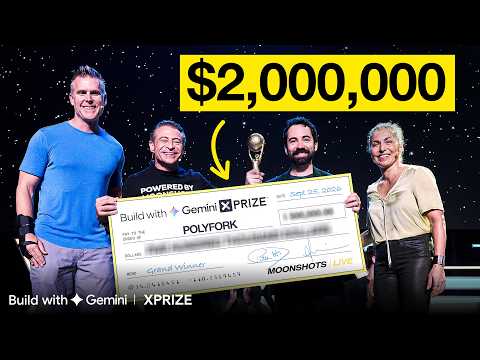
We Gave Away $2,000,000 To 5 AI Builders | MOONSHOTS Live
Peter DiamandisSalim IsmailDave BlundinAlexander Wissner-GrossCathie Wood
Peter Diamandis says the education-to-employment contract is “done,” while Build with Gemini XPRIZE tests whether teams can build profitable companies around problems affecting 100,000 people in 90 days.Cathie Wood calls a one-person AI startup a career “call option” despite a 90% failure rate, and Logan Kilpatrick says data—not compute—now constrains progress, favoring unique datasets and domain expertise.
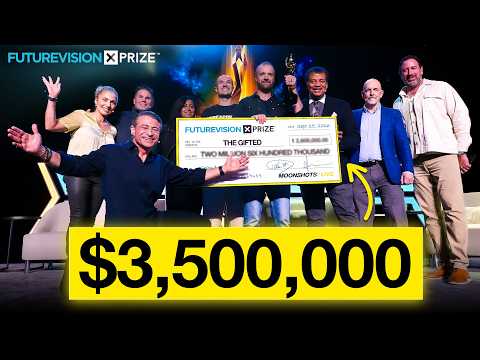
Why We Gave Away $3,500,000.00 for Someone to Build the Next Star Trek | Moonshots Live
Peter DiamandisSalim IsmailDave BlundinAlexander Wissner-Gross
Future Vision X Prize turned optimistic-future storytelling into a scaled creator funnel: more than 5,000 participants, over 2,500 submissions, 50 scripts, and five finalists.Peter Diamandis cited Claude’s sandbox behavior to argue that media trains children and AI models; whether constructive narratives can redirect engineering and model behavior remains unresolved, with science still answerable to nature.