SHOW DIRECTORY
The Cognitive Revolution
Detailed conversations with AI researchers and builders about frontier models, agents, safety, policy, and the path toward advanced intelligence.
BIDCLUB DESCRIPTION
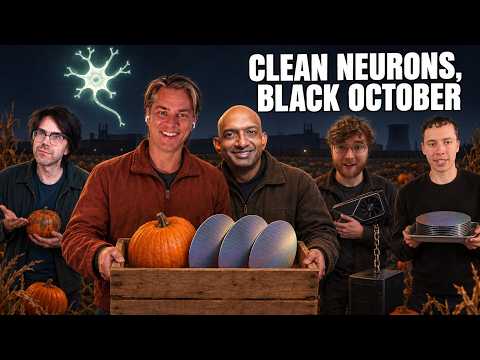
AI:AM Highlights: Clean Neurons, Black October, the GPU Credit Crunch, and Buying the Supply Chain
Nathan LabenzPrakash NarayananZvi MowshowitzEvan ConradLonis Hamaili
Zvi Mowshowitz sketches a conditional weekly-release path; contacts call 2027 “completely crazy” and say 2028 “might be unrecognizable.”Evan Conrad says GPU financing is constrained “entirely” by credit; three-to-five-year commitments and sometimes 100% upfront payments could force lab sales within one or two years.Cambrian sees memory rerating from five-to-six times earnings to 10–12 times if demand keeps outrunning supply.

AMA Part 1: Is Claude Code AGI? Are we in a bubble? Plus Live Player Analysis
Frontier AI is already clinically transformative and can outperform professionals on a significant majority of software tasks, yet Claude Opus 4.5 remains spiky, requiring full-context review after accidentally creating two databases.Google DeepMind combines the strongest financial cushion, distribution, TPUs, and research breadth, while OpenAI’s interlocking obligations and infrastructure ambitions create default risk; Anthropic’s model leadership, Chinese-model gaps, xAI’s safety failures, and another MRD result remain key signals to monitor.

AMA Part 1: Is Claude Code AGI? Are we in a bubble? Plus Live Player Analysis
Erik TorenbergNathan LabenzZvi MoshowitzGregEugenia KuydaAli BehrouzLogan KirkpatrickJungwon Hwang
AI’s strongest proof point is its performance alongside Nathan Labenz’s son’s oncologists, with minimal residual disease below one cell per million after remission before round two.Claude Opus 4.5 may be software AGI, but jagged failures and holiday hype leave full AGI unresolved, while context management, multi-model judgment, and infrastructure financing remain key risks.