EtherFi ($ETHFI) - it’s somehow just make sense ...
Gonna be honest with you. When I first started writing this piece, I struggled quite a bit. I know that I’m super bullish on the project, but for some reason, it’s hard to justify my bullishness in the linear narrative style of a typical report.
EtherFi doesn't boast a revolutionary new technology (e.g. no fancy zero knowledge stuffs), isn't riding the hottest new meta (e.g. AI), and doesn't even riding on a new popular meta (like Hyperliquid).
Yet, as someone who spent the better part of his career in TradFi, consulting, and centralized crypto firm (before going full degen) — I can’t help to feel that their business just… makes a lot of sense.
Let me try my best to unravel that.
Combining Two Classic, yet Proven Propositions
Most of us probably know EtherFi from the restaking craze in 2024. Back then, it was among the first to offer liquid restaking tokens that integrated seamlessly with major DeFi platforms like Pendle and Aave, quickly amassing billions in TVL.
This staking and restaking model remains their primary proposition: put your ETH to work efficiently, stake it, and earn attractive yields (currently around 5–8% APY).
While it’s maybe groundbreaking when it launched, but certainly not revolutionary today—especially with the rise of numerous competitors in the liquid staking derivative market. Furthermore, with ETH entering a slump in the first half of this year, their momentum quickly faded.
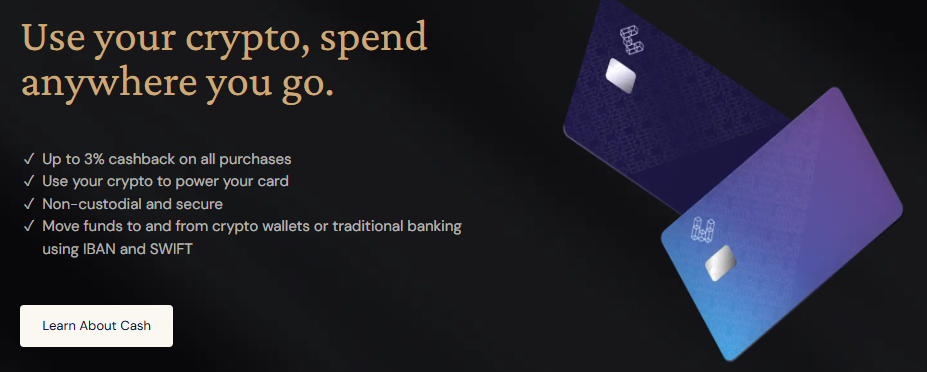
However, the team was quietly building behind the scenes. In April 2025, EtherFi launched its second proposition: EtherFi Cash, a comprehensive crypto payments and cards offering. The premise is elegantly simple: you stake your ETH, earn yield, and can then spend your yield directly on real-world goods and services.
Cardholders can choose between two spending modes:
- ◆Direct Pay: Your crypto assets are swapped instantly to USDC at the point of sale.
- ◆Borrow Mode: A short-term line of credit collateralized by your staked eETH or vault balances.
And again .. Nothing too groundbreaking from this business - numerous CEXs and DeFi apps offer similar solutions—but it’s a proven winner, providing both tangible benefits (volume, revenue) and intangible value (user loyalty, engagement, brand stickiness).
They Say that Revenue Is the Most Desirable Feature
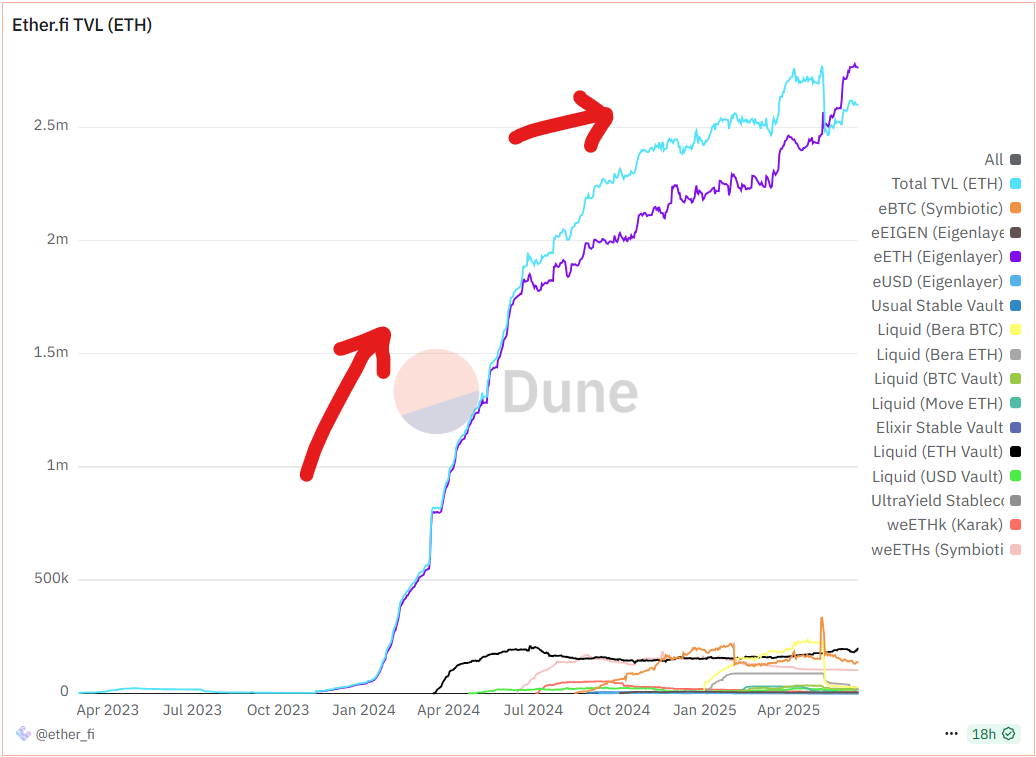
At time of this writing (11 June 2025), EtherFi has around 2.6 million ETH staked, which translates to about $7.3 billion TVL and ~85Mn Fees paid by their users (see DeFiLlama - EtherFi).
Though somewhat moderated (compared to their 2024 height), their staking-restaking business remains strong - capturing lion shares of the key restaking platforms (~48% of EigenLayer, ~37% of Symbiotic). Given this market leader perception, I would argue that EtherFi would still be in the best position to capture the ongoing positive narratives surrounding ETH and staking:
- ◆Increasing composability of restaking Liquid Staking Token (i.e. using LST as yield source for Stablecoin)
- ◆Ongoing discussion to allow “Staking” in ETFs
- ◆Institutional appetite on DeFi token (i.e. ”they are coming for your token!”)
Now, shifting our attention to EtherFi Cash - it’s a bit early to chart a clear growth trajectory. However, using typical credit-card unit-economics and EtherFi’s initial metrics as a guide, achieving profitability will likely be quite challenging.
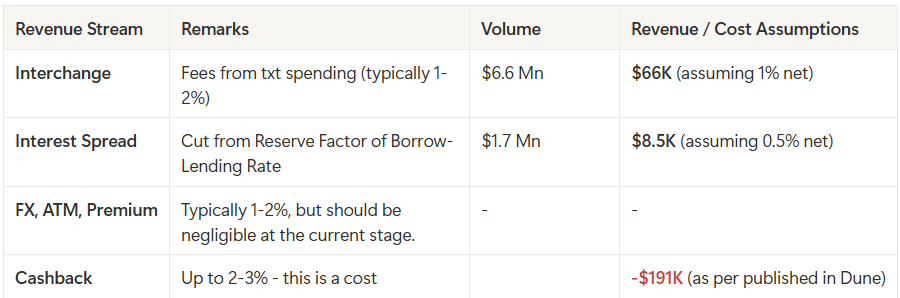
Furthermore, based on my understanding on highly competitive card businesses - “scale” does very little to improve the profitability, especially in the short-term (at this stage, they probably need to increase their acquisition cost & loyalty / cashback spend to be competitive).
Yet, there are compelling reasons why virtually every financial institutions in this planet wants to have a card business:
- ◆Customer Stickiness: Cards create habitual usage, everytime you use your EtherFi card, you’ll be also thinking about your staking portfolio.
- ◆Brand Visibility: Physical cards boost brand presence, it also provides a lot of way for EtherFi to position their brand and segment their users (see EtherFi Club memberships)
- ◆Broad Market Appeal: Cards is a known, familiar proposition especially to mainstream customers not familiar with blockchain technology - this will help EtherFi to potentially acquire new users back to their main staking business.
For EtherFi in the longer term, the card business could feed directly back into its primary staking revenue stream, effectively creating a sustainable flywheel—users stake more ETH to fund purchases or credit lines, leading to increased staking revenue.

Simpler Value Accrual is Best
When it comes to token value accrual, simplicity often wins. DeFi protocols usually employ two straightforward models:
- ◆Direct revenue sharing through staking.
- ◆Token buybacks.
EtherFi simply combines both approaches:
A portion of protocol revenue, ranging from 5% to 25% monthly, along with exit fees revenue, is allocated to purchase ETHFI tokens from the open market. These tokens are then deposited into the ETHFI staking pool, effectively distributing revenue back to stakers.
Recent buybacks have been substantial, reaching approximately 100–137 ETH per week, demonstrating clear and direct value accrual to token holders.
But the Token Supply Management is Quite Concerning…
$ETHFI currently has a circulating supply of about 330 million out of a fixed total of 1 billion tokens. There's a significant token unlock schedule continuing until 2027, particularly heavy in:
- ◆Investors & Advisors (32.5%): 1 year cliff + 2 year vesting, starting from 2024, so unlocking starts 2025-2027
- ◆Core Team & Contributors (23.3%): 3 years vesting 2024-2027
So there’s still quite a solid chance that those people may dump on you, though you can argue that this is easier to manage since it’s somewhat predictable (see the kink in Jan’2025-Jan’2026).
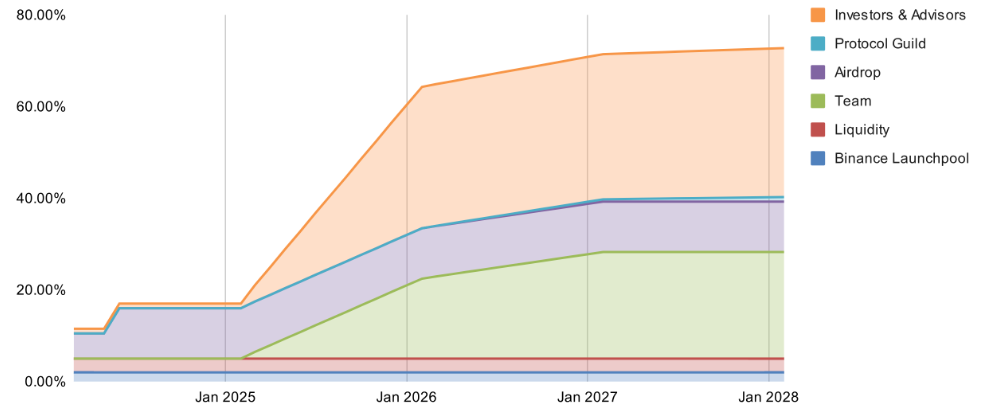
Image credit: Binance Research
Not Your Next 100X, But a Solid Bet in This Market Environment
At time of this writing, $ETHFI price hovers around $1.2-1.3, signifying an FDV of $1.2-1.3Bn - so you should not expect this to be your next 10-bagger.
However, I would argue that $ETHFI deserves a place in your portfolio - especially if you believe the following will happen in crypto:
- ◆ETH Continues as De-Facto #2 Crypto Asset (After BTC)
- ◆ETHFi has +2.2 beta and +0.9 correlation against ETH (last 60 days) - basically giving you amplified exposure to ETH
- ◆Crypto deregulation hits the industry in full force, opening the wave for insti + retail into
- ◆TradFi bros & normies love yield —> staking the top DeFi assets in market leading provider will be #1 destination
- ◆Crypto-Payments platforms are the real winner from GENIUS Act’s
- ◆“Stablecoin as payment” use-cases becomes more mainstream
In Summary …
- ◆Strong business fundamentals (bery gud)
- ◆Classic, proven staking and payments propositions with clear revenue streams and a promising flywheel effect from their card business.
- ◆Compelling narrative (gud)
- ◆Riding on the ETH revival narrative and the broader trend of crypto deregulation and payments mainstreaming.
- ◆Slightly mixed on the token dynamic (meh)
- ◆Clear and simple value accrual methods for token holders, but non-zero chance of insider selling risks due to significant future token unlocks.
All-in-all, EtherFi might not become your explosive 10x investment, but it undoubtedly earns its place as a compelling, fundamentally sound play to ride the existing meta in the market.
Affiliate Disclosures
- •The author and/or others the author advises do not currently hold, or plan to initiate, an investment position in target.
- •The author does not hold an affiliated position with the target such as employment, directorship, or consultancy.
- •The author is not being compensated in any form by target in relation to this research.
- •To the best of the author's knowledge, the information provided here contains no material, non-public information. The accuracy of the information is the responsibility of the reader.
7
0