PERSON DIRECTORY
swyx
Host of Latent Space. swyx appears in 64 indexed conversations across Latent Space, No Priors, The Cognitive Revolution. This directory brings every appearance, source, TL;DR, digest, and transcript into one searchable feed.

The Programmable Data Center — Evan Conrad, SF Compute
SF Compute’s bet is that GPU trading requires cloud-like operations: VM configurations can differ by 40%, leaving financial contracts exposed to manipulation and basis risk before reliable delivery.On the 5% of capacity listed, customers recover $25 per $100 spent through resale; Conrad reports several hundred million dollars in volume, but order-book volume remains small, leaving lender-financeable forward-curve liquidity unproven.

AI:AM: A Level We Shouldn't Pass? Notes from The Curve + Tokens vs. Salaries & Is SaaS Cooked?
Nathan LabenzThomas SohmersswyxEvan MiyazonoEdward Hu
Frontier insiders increasingly treat powerful AI as operational reality, while a lab leader accepted a possible 10^27 FLOPs ceiling, making compute and synthetic-data governance live constraints.Memory costs are tightening: Positron cites a 4.5-times quote increase in one year and one week, yet over five-times capability gains per fixed memory.Agentic coding threatens generic CRUD SaaS while expanding bespoke software, but coordination, evaluation and reliability remain unresolved risks.

The Future of AI Infra: from Kubernetes to Agent Sandboxes — Akshat Bubna, Modal CTO
Modal is repositioning infrastructure around agent experience, using decorators, CLI observability, and a 17-provider footprint instead of owning data centers.Its investment case rests on bursty workloads and elastic orchestration: speculative decoding may deliver 2× to 4× speedups, while batch pricing and reliability determine whether compute planning converts into margins.

AI Agents Need Computers: 74% MoM Growth, 850K/Day Runs, & New Agent Cloud — Ivan Burazin, Daytona
Daytona is repositioning the sandbox as an API-addressable, stateful computer for AI agents, reporting 74% month-over-month growth versus roughly 40% for the broader infrastructure market.Bare-metal scheduling, local NVMe snapshots and pause-resume state deliver 60-millisecond starts, but RL/eval bursts can drive 100,000 CPUs at once, leaving 15% average utilization and making committed capacity and GPU-CPU coordination central to scale.

The Agent-Native Cloud: 3M Users, 100K Signups/Wk, Data Centers, & Death PRs — Jake Cooper, Railway
Alessio FanelliswyxJake Cooper
Railway is betting agents will dominate software building, using bare metal and a versioned, forkable application layer to turn deployment into continuous, reversible evolution.Hardware reportedly pays back in about three months with roughly 70% margins, but CI/CD may melt under parallel workloads; autonomous remediation, eventual GPUs, and disciplined capacity financing remain key watchpoints.
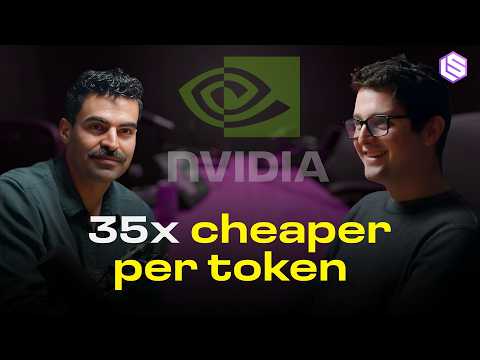
Agent Inference at the "Speed of Light" — How NVIDIA moves like a $4.3 Trillion Startup
swyxVibhuNader KhalilKyle Kranen
NVIDIA’s Dynamo treats agent inference as a data-center-scale system, coordinating KV-cache-aware scheduling, disaggregated prefill and decode, and heterogeneous fleets above vLLM, SGLang, and TensorRT-LLM.The economic frontier is quality, cost, and latency across the entire workflow, with GB200 NVL72 cited as roughly 35 times cheaper per token than Hopper over much of one comparison curve.Brev’s DGX Spark integration and NVIDIA’s agent rollout could expand GPU access, but security controls remain unresolved as agents combine file access, internet access, and arbitrary code execution.
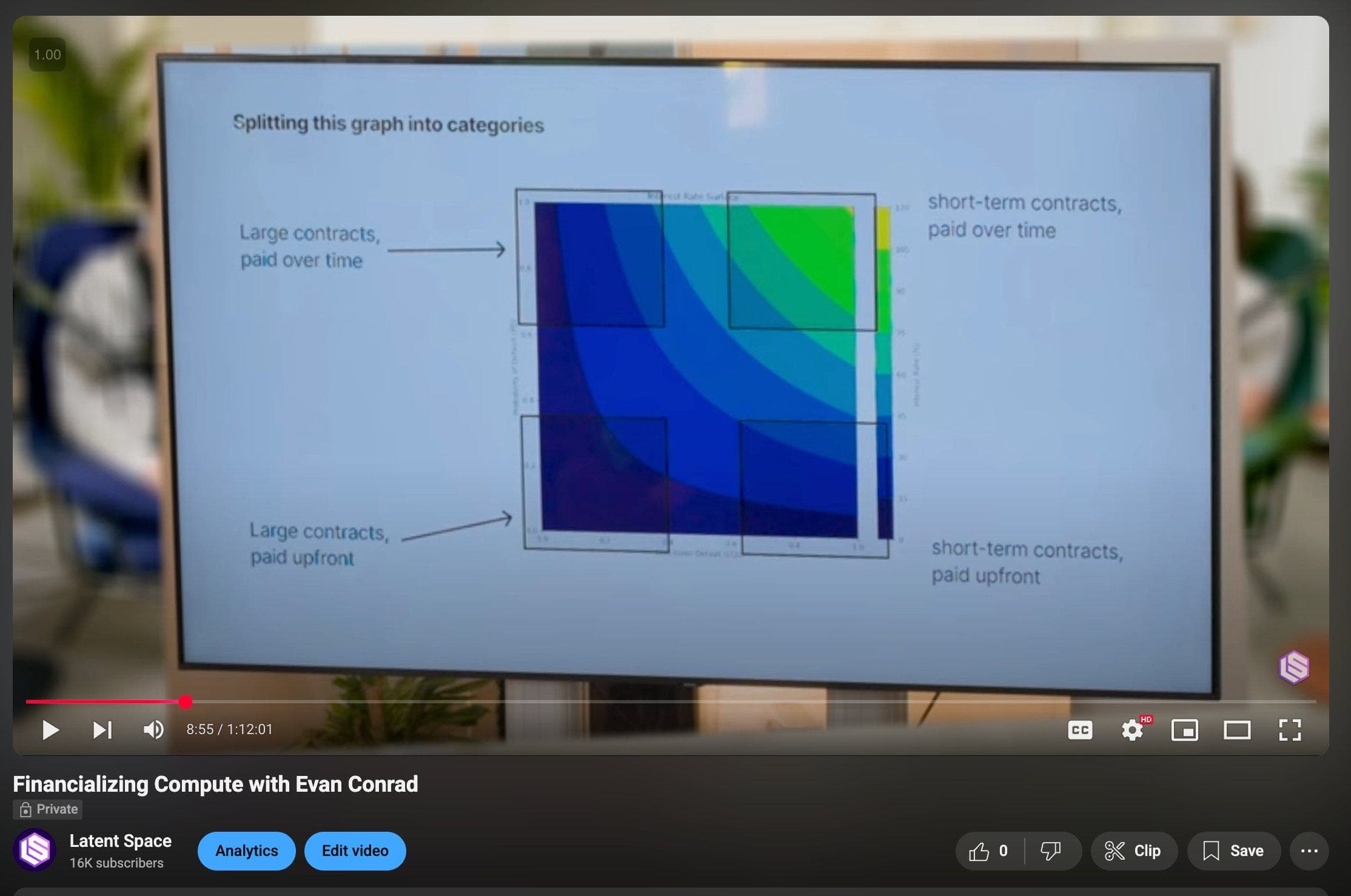
SF Compute: Commoditizing Compute to solve the GPU Bubble forever
Alessio FanelliswyxEvan Conrad
SF Compute treats GPUs as tradeable, financeable capacity rather than software infrastructure, turning unused commitments into a spot market and separating hardware ownership from higher-margin software businesses.Long-term contracts with creditworthy customers can make GPU ownership resemble real estate, while hourly resale improves utilization and flexibility; a future cash-settled GPU index could reduce financing risk, but standardization, chip supply and physical cluster reliability remain unresolved.