SHOW DIRECTORY
Latent Space
Technical conversations for AI engineers and builders covering models, agents, developer tools, inference, data, and production infrastructure.
BIDCLUB DESCRIPTION
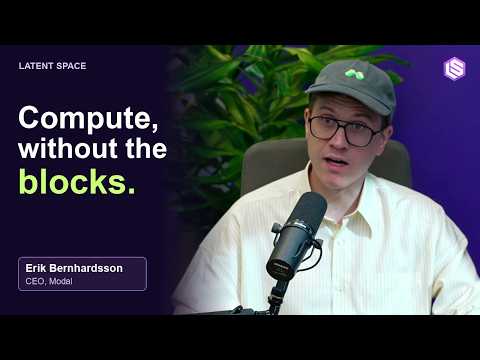
Why AI Compute Comes in Rectangles — Erik Bernhardsson, Modal
VibhuBasil ChathaErik Bernhardsson
Bernhardsson estimates Modal is at least 50× larger, with Sandboxes now a third of revenue and growing 30% month over month.As GPU supply shifts to almost 25 clouds and three-plus-year prepaid deals, Modal can aggregate thousands of customers to flexibly slice “three-year rectangles.”Locked-in reservations leave Modal exposed if GPU prices and utilization fall together.

The Recommendation Engine for Commodity Traders — Anekha Sokhal, Moshi
Moshi uses an internally built recommendation system to surface second- and third-order market effects a news stream may miss.Its graph combines futures, fundamentals, news, X, podcasts, and private data; Sokhal says answers that take days can arrive in 30 seconds.Yet swyx questions trading on noisy, potentially manipulated X data, citing about $300,000 monthly for Balyasny's X Firehose; Moshi scores confidence, but any opportunity remains unknown.

AI in NYC: How Tenex Builds an AI-Native Engineering Team — Alex Lieberman & CJ Hess
Among about 100 enterprises 10X talks to, 90% have rolled out Claude or Codex, but only about 5% have non-engineering agents in production, revealing the last-mile gap.CJ estimates output roughly doubled from December’s “Opus 4.5 moment” to Opus 5.5; scaling still requires process standardization and permissioning.

The Programmable Data Center — Evan Conrad, SF Compute
SF Compute’s bet is that GPU trading requires cloud-like operations: VM configurations can differ by 40%, leaving financial contracts exposed to manipulation and basis risk before reliable delivery.On the 5% of capacity listed, customers recover $25 per $100 spent through resale; Conrad reports several hundred million dollars in volume, but order-book volume remains small, leaving lender-financeable forward-curve liquidity unproven.
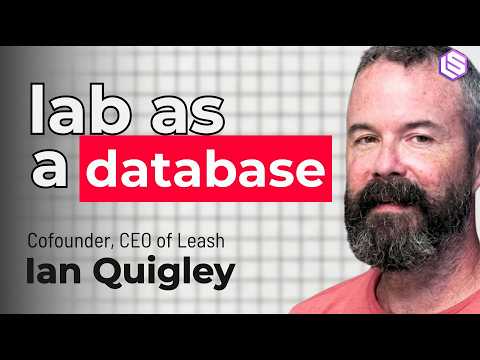
Why a 4-Billion-Point Kaggle Dataset Still Couldn’t Beat Chance — Ian Quigley, Leash Bio
Ian QuigleyBrandon AndersonRJ Honicky
Leash’s reported edge is low-cost, carefully characterized data: its ten-person operation developed about 2,000 protein constructs and ran roughly 5,000 screens.On the hardest Kaggle split, none of roughly 2,000 teams beat chance, exposing how poorly models transfer to distant chemistry.Language agents now test hypotheses instantly against measured compounds, but coverage remains limited and potency calibration unfinished.
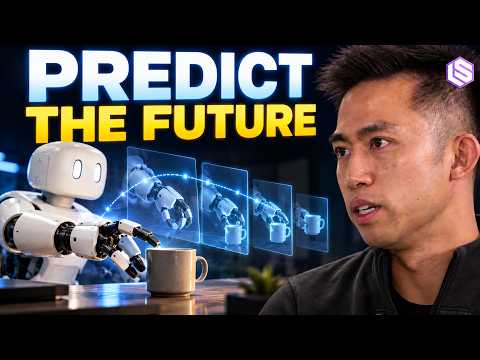
The Bitter Lesson of Robotics: Why Scaling Wins — Jason Ma, Dyna Robotics
Multi-site deployments folding thousands of napkins daily at Din Tai Fung and laundry for Best Western offer commercial proof beyond pilots; Din Tai Fung has signed a much bigger contract.Jason calls Dyna-2 the first world action model trained on more than 1 million hours of data, but missing sensing modalities remain a potential constraint on broader generality.
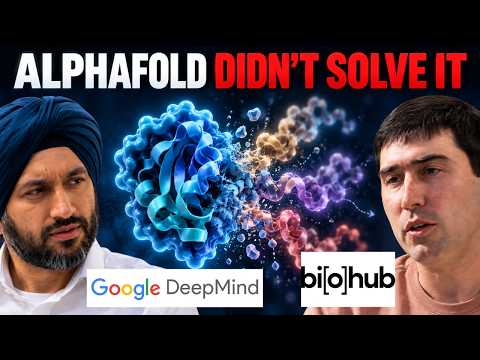
Why AlphaFold Didn't Solve Protein Folding — Pushmeet Kohli, Google DeepMind & Sal Candido, Biohub
Pushmeet KohliSal CandidoBrandon Anderson
AlphaFold 2 reproduced PDB-deposited structures, but ground state, dynamics, function, and design remain open, shifting the frontier toward richer biological context and raw cryo-EM data.Metagenomic sequences show useful scaling depends on statistical fit rather than volume, while calibrated pLDDT and clearer bottlenecks—not a 10x or 100x timetable—determine whether AI can safely accelerate drug development.
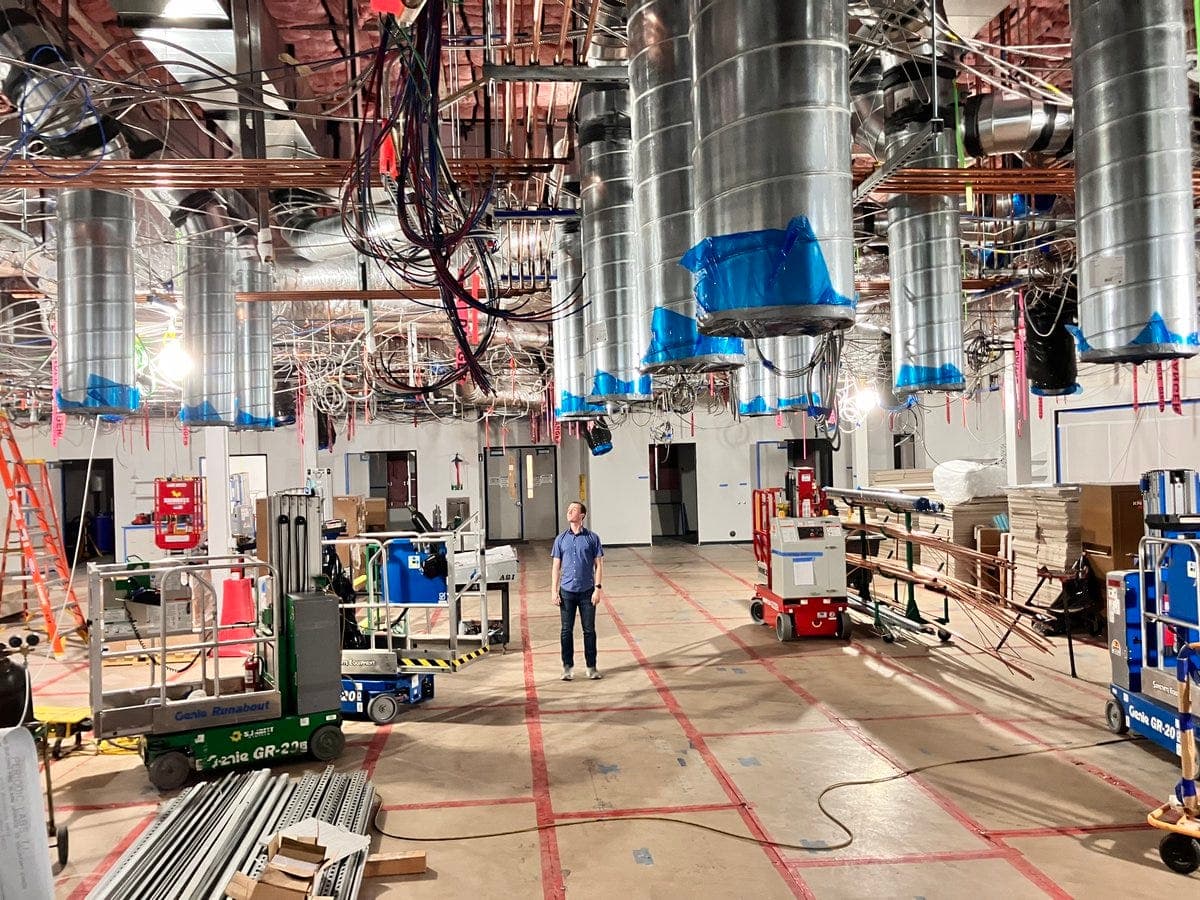
Synthesis Superintelligence: from Semiconductors to Superconductors — Periodic Labs’ Liam Fedus and Ekin Dogus Cubuk
swyxBrandonLiam FedusEkin Dogus Cubuk
Periodic’s differentiated asset is timestamped lineage across failed experiments, computations, instrument data, code, discussions, and successes, enabling models to learn scientific process rather than published endpoints.Its AI-simulation-experiment loop targets automated characterization, with secure on-site semiconductor deployment as the near-term wedge, while the longer-term “matter compiler” faces unknown physical variables and difficulty discovering superconductors without a complete theory.
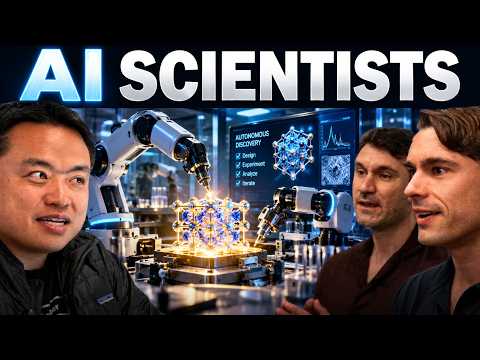
AI Scientists Are Here: Autonomous Labs & Synthesis Superintelligence — Periodic Labs
swyxBrandonLiam FedusEkin Dogus Cubuk
Periodic Labs is building AI, simulations, and high-throughput physical labs as a closed loop, with timestamped failures, instrument data, and campaign lineage potentially differentiating its scientific intelligence.Automated characterization—not humanoid robotics—is the near-term bottleneck, while secure on-site deployments for semiconductor companies could evolve from Copilot-style assistance toward outcome pricing; whether throughput can compress discovery without better physical representations remains the key risk.

Recursive Language Models — Alex Zhang, MIT PhD
Alex Zhang sees openings for smaller AI labs in overlooked research bets and output architectures, with JEPA potentially cutting binary-classification inference costs by 400 times while expert verification remains scarce.RLM and Prime Agent replace trajectory-as-a-prompt loops with persistent state and code-native delegation, but reported swarm economics—10,000 agents, 88 hours, 130 billion output tokens, and about $40 million—make orchestration and reliability the key watchpoints.