PERSON DIRECTORY
David George
David George appears in 12 indexed conversations across The a16z Show, 20VC, Invest Like the Best. This directory brings every appearance, source, TL;DR, digest, and transcript into one searchable feed.
The Biggest Shift in Cybersecurity in 30 Years
AI is shifting cyberattacks from resource-constrained “sniper shots” to scalable swarms, while Armadin continuously verifies exploitable network weaknesses.Since January 2026, Armadin has found more than 90 zero-days across Fortune 500 customer environments, while Blue aims to turn a five-minute lead into autonomous controls.With technical advantages potentially copied in six months, customer execution and the Red-to-Blue feedback loop remain the operating test.
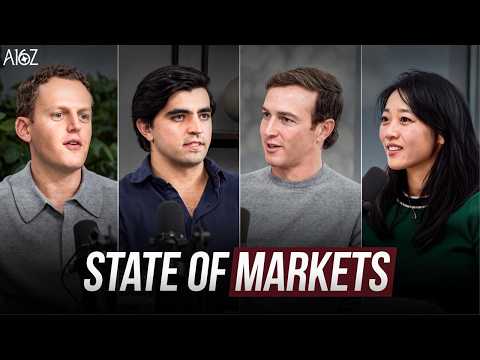
AI, Infrastructure, and the Next Investment Cycle
David GeorgeSarah WangAlex ImmermanSantiago Rodriguez
AI’s rally is being driven by earnings rather than multiple expansion, with the S&P 500 below 20 times earnings while growing about 15%.Capex is projected to rise from $416 billion in 2025 to about $780 billion in 2026 and exceed $1 trillion annually from 2027; enterprise adoption remains concentrated in pilots, with inference-cost declines and workflow deployment as catalysts.

Why Investors Are Rethinking Everything for the AI Era
Jen KhaDavid GeorgeAram Verdiyan
AI is making capital itself compound advantage, pushing venture’s power law beyond prior tech cycles as compute improves products and inference demand remains unlimited.Only 20 of 3,000 US VC firms produced consistent 3x net returns over two decades, supporting concentrated LP portfolios and 5–10%+ late-stage sizing in category-defining companies.Meanwhile, traction is harder to parse and pre-ChatGPT software LBOs face repricing, leaving diffusion, liquidity, and power access as key risks and catalysts.
Why AI Demand Is Outrunning Compute Supply
AI demand accelerated through July and August, with usage concentrated among possibly sub-10 million heavy users and no leader identifying a worsening quantitative metric.Nebius suggests nine-to-ten-month paybacks on $50B-per-gigawatt builds, supported by 50-60% customer prepayments; undersupply through ’28 could lift token prices, while shifting capacity to training could cut lab revenue from $480B to $120B.

How Whatnot Made Online Shopping Fun Again
Live commerce’s US share is still in the “single digits” versus 30-40% in China, with Whatnot arguing that $0 global storefronts can expand demand rather than merely shift offline sales online.Over $8B in sales last year and so far this year, 95-minute daily engagement, and seller EBITDA margins of 20, 30, 40-plus percent make category expansion and trust-and-safety execution key tests.
“Checkout Pages Should Not Exist" - Stripe on Agentic Commerce
Stripe’s first-half signups grew 50% YoY, while the median 2026 cohort generates 50% more revenue than 2025’s and its new SaaS-platform cohort is 103% larger.Stripe Minions produce 7,000 weekly one-shot PRs, KAI lifted seller productivity 20%, and Machine Payments Protocol, Link Agent Wallet, and Tempo offer potential catalysts as agentic commerce adoption and execution remain unproven.
The New Rule for Picking AI Winners | The a16z Show
OpenAI and Anthropic now add more monthly revenue than Meta, Google, or Microsoft despite AI diffusion below 5%, making “in the token path” George’s rule for application winners.Five frontier labs could lower token prices, but Chinese models reportedly offer 80% of frontier capability at 10% of the cost; scarce capacity lasts through early 2029, with algorithmic breakthroughs the key reversal risk.
AI Markets: Deep Dive with a16z's David George
AI-native companies grow more than 2.5x faster, with top performers reaching 693% year-over-year growth and $500,000-$1 million of ARR per employee.Engagement and operating evidence includes Navan handling 50% of travel interactions with AI and expanding gross margins 20 percentage points, while enterprise change management remains the key execution risk.
The Biggest Bottlenecks For AI: Energy & Cooling
AI infrastructure is becoming a utility layer: big-tech capex annualizes near $400 billion, model-access costs fell more than 99% in two years, and ChatGPT reached 365 billion searches in two years.Energy is likely the next five-year bottleneck, followed by cooling, while application durability depends on 90% or more retention, easy acquisition, and workflow depth rather than model access alone.

a16z's David George on the Most Controversial Bet at a16z & Do Margins and Revenue Matter in AI?
a16z’s strongest-performing fund was a $1B vehicle, with Databricks returning 7x and Coinbase 5x in DPI alone as private markets surpassed $5T.AI is shifting budgets from labor to technology, with CH Robinson reporting 40% productivity gains and 680bps of operating-margin expansion, while retention and engagement—not SaaS margins—become the crucial proof of AI demand.