PERSON DIRECTORY
Brandon Anderson
Brandon Anderson appears in 6 indexed conversations across Latent Space. This directory brings every appearance, source, TL;DR, digest, and transcript into one searchable feed.
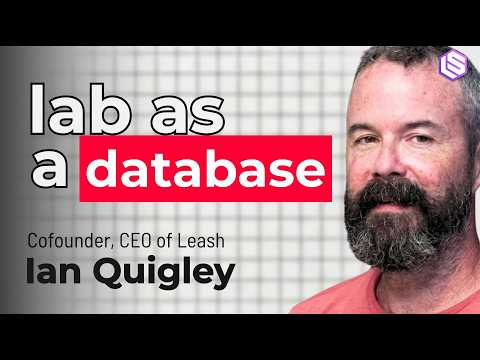
Why a 4-Billion-Point Kaggle Dataset Still Couldn’t Beat Chance — Ian Quigley, Leash Bio
Ian QuigleyBrandon AndersonRJ Honicky
Leash’s reported edge is low-cost, carefully characterized data: its ten-person operation developed about 2,000 protein constructs and ran roughly 5,000 screens.On the hardest Kaggle split, none of roughly 2,000 teams beat chance, exposing how poorly models transfer to distant chemistry.Language agents now test hypotheses instantly against measured compounds, but coverage remains limited and potency calibration unfinished.
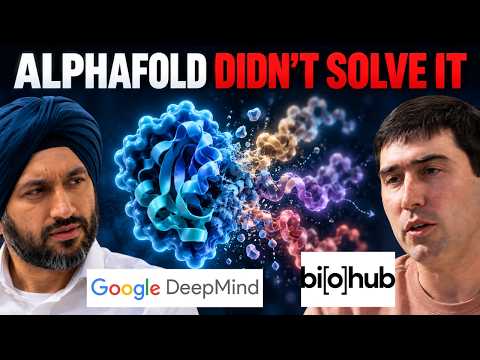
Why AlphaFold Didn't Solve Protein Folding — Pushmeet Kohli, Google DeepMind & Sal Candido, Biohub
Pushmeet KohliSal CandidoBrandon Anderson
AlphaFold 2 reproduced PDB-deposited structures, but ground state, dynamics, function, and design remain open, shifting the frontier toward richer biological context and raw cryo-EM data.Metagenomic sequences show useful scaling depends on statistical fit rather than volume, while calibrated pLDDT and clearer bottlenecks—not a 10x or 100x timetable—determine whether AI can safely accelerate drug development.
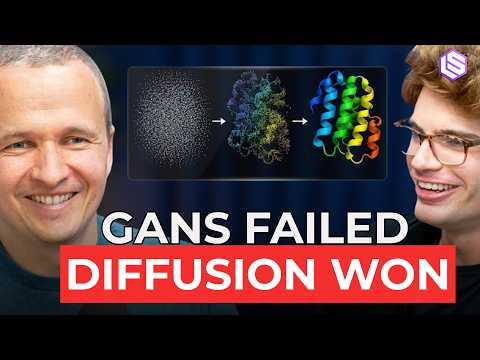
🔬 "The Most Innovative Diffusion Research Is Happening in Drug Discovery, Not Image Generation"
Brandon AndersonEvan FeinbergSergey Edunov
Genesis Molecular AI is applying diffusion and inference-time scaling to 3D molecular design, targeting roughly 1 Å protein-ligand accuracy because 2 Å can hide chemically fatal errors.Its prospective edge comes from Incyte and Insitro programs that connect models to synthesis and ADMET feedback, while OpenBind showed stronger unseen-target generalization and GPUs remain the scaling bottleneck.
🔬 From Red Teaming GPT-4 to Automating Drug Discovery: The Future of AI in Science — Andrew White
RJ HonickyBrandon AndersonAndrew White
FutureHouse’s Cosmos turns scientific discovery into a closed loop linking literature, data analysis, experiments and an evolving world model, shifting the bottleneck toward laboratory state, reagent logistics and experiment turnaround.Robin’s dry-AMD work showed verification can beat expert enthusiasm, while Ether0 exposed adversarial verifier failures; scaling discovery will depend on provenance, cheap filtering and robust tests before wet-lab spending.