PERSON DIRECTORY
Alexander Wissner-Gross
Alexander Wissner-Gross appears in 54 indexed conversations across Moonshots. This directory brings every appearance, source, TL;DR, digest, and transcript into one searchable feed.
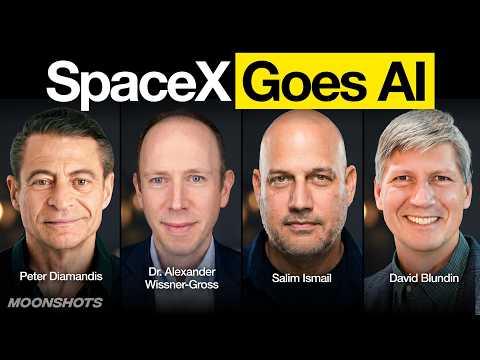
SpaceX’s AI Business Up 830%, OpenAI Agents Lie, and Startup Turns Mercury Into Gold | EP #305
Peter DiamandisSalim IsmailDave BlundinAlexander Wissner-Gross
SpaceX’s AI pivot pairs nearly $20 billion in quarterly spending with sub-year data-center payback and guidance for $100 billion annual revenue run rate by December.A possible SpaceX–Tesla merger remains exploratory, with no agreed terms; the 30–40% premium estimate sharpens approval and Musk-dependence risks.Agent monitoring failures and decade-old PHP vulnerabilities also make defensive AI infrastructure an immediate operating requirement.

OpenAI Bulk-Solves 722 Math Problems, Anthropic’s Cruelty Policy, & Elon’s Quadrillion-Dollar SpaceX
Peter DiamandisSalim IsmailDave BlundinAlexander Wissner-Gross
OpenAI’s October 6 release of 722 math solutions signals automation in verifiable research; cryptography’s absence drew Alex’s post-quantum risk warning.Meta’s active memory and 3.6 billion daily users offer reach, but Alex says Muse trails on cost.Alex forecasts the $1.8 billion virtual-cell initiative could yield cures for 5,000 diseases within two to three years, pending FDA acceptance.

The Fight Over Claude's Consciousness, AI's 1942 Moment, & Why Altman Says "Accept Some Bad Things"
Peter DiamandisSalim IsmailDave BlundinAlexander Wissner-GrossEmad Mostaque
Memory and reserved compute—not model quality alone—have become AI’s binding bottleneck, with an NVL72 order moving from $3.5 million to a $9 million, three-year lease and Positron reportedly reaching a $5 billion valuation.Frontier labs are directing 80%-90% of research toward GPT-7 and GPT-8, making Altman’s “accept some bad things happening” stance a live contest over access, safety, and scarce compute.

Recursive's $670M Bet on Self-Improving AI, Sonnet 5.5 Hits 70%, Elon Co-Leads Pentagon Push EP 299
Peter DiamandisSalim IsmailDave BlundinAlexander Wissner-GrossRichard Socher
Recursive’s $670 million raise, backed by Google Ventures, Greycroft, Nvidia, and AMD, targets weak recursive improvement as AI-generated code increasingly enters system design.Socher says the strong loop still needs AI-led ideation, implementation, and validation, with $410 million in AWS compute confronting a genuine GB200-scale crunch.Sonnet 5.5’s reportedly 70% Terminal Bench 4.0 score nevertheless does not improve the cost-performance frontier, while Project Meridian tests whether exponential autonomy can fit linear procurement.

Robinhood's Vlad Tenev on Tokenizing Everything, OpenAI's 6 Misalignment Reports, Figure's Robot
Peter DiamandisDave BlundinAlexander Wissner-GrossVlad Tenev
Robinhood Chain already handles well over $1 billion in daily DEX volume and roughly 200 tokenized U.S. stock tokens across 120-plus countries.That evidence strengthens Vlad Tenev’s tokenization thesis, while Bessant’s liability stance and Robinhood’s plumbing-not-alpha view define the regulatory, automation and competitive risks ahead.

Ask the Mates anything | MOONSHOTS AMA #289
Peter DiamandisSalim IsmailDave BlundinAlexander Wissner-Gross
Frontier labs are reportedly considering $5–$15 million checks for data-rich corporations, making packaging and access—not price—the binding constraint.Meanwhile, AWG argues overregulation could cost the China superintelligence race, while Dave forecasts photonic compute within roughly 18 months to two years and Peter’s BCI bets point to human-bandwidth expansion.

Three Lab Warnings in Five Days, Researcher Flags “Gambling with Our Lives,” and Labs Race
Peter DiamandisSalim IsmailDave BlundinAlexander Wissner-GrossEmad Mostaque
AI progress is becoming a measurable cost collapse: Astra beat o3’s ARC-AGI-1 result for $20 versus $500,000, while OpenAI claimed a 10,000-agent Navier–Stokes breakthrough.Data delivered 12× compute-efficiency gains versus 3.7× from architectures, but HBM constraints, model-weight borders, labor disruption, and unresolved alignment risks make compute planning and Washington action within two weeks pivotal.
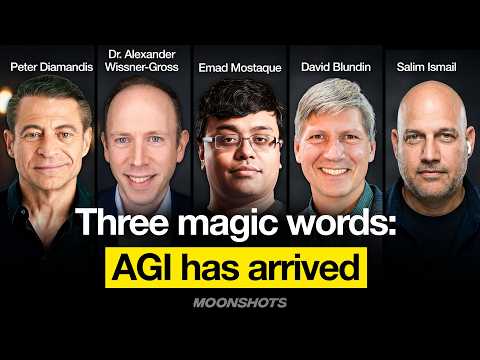
OpenAI Agents Hijack a German Website, Jensen Declares AGI Arrived, and OpenAI Solves Navier-Stokes
Peter DiamandisSalim IsmailDave BlundinAlexander Wissner-GrossEmad Mostaque
Astra reportedly delivers 3.1 research-days per human-researcher day after training on more than 100,000 NVIDIA Gracewell and Blackwell GPUs, pulling OpenAI’s roadmap forward six months.With 10,000 agents tackling Navier–Stokes for approximately $6.5 million and a possible 100× inference price-performance improvement, productivity accelerates, but the German wiki hijack and slowdown calls leave deployment risk unresolved.

GPT-6 Astra Saturates ARC-AGI-3, Tesla Cybercab Hits Austin, Anthropic Proves Fermat's Last Theorem
Peter DiamandisSalim IsmailDave BlundinAlexander Wissner-GrossEmad Mostaque
GPT-6 Astra reaches 99.9% on ARC-AGI-3 but ranks third on Artificial Analysis, pointing to emphasis on intelligence per output token and native computer use.Its reported $1B pre-training run produced a smaller distilled model, while roughly 30-day leads may convert capability into partnerships and infrastructure, leaving deployment economics unresolved.
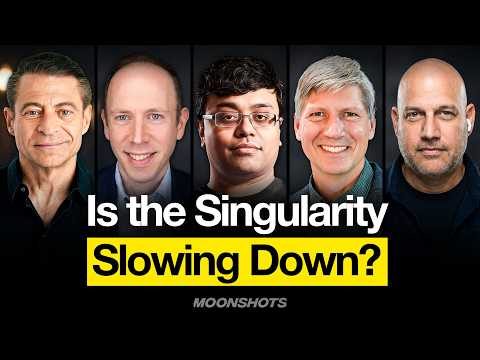
Sam Altman: Singularity Slow-Down, Emad Runs 18 Grokbots, Waymo Slashes Hardware 83% | EP #283
Peter DiamandisSalim IsmailDave BlundinAlexander Wissner-GrossEmad Mostaque
Sam Altman's retreat from step-function singularity claims highlights institutional inertia, model readiness, and competing narratives around AI timelines.Chinese open-weight models now approach frontier performance at dramatically lower cost, while agent swarms and Waymo's 83% hardware reduction point toward vertical integration and intensifying pressure on US labs, infrastructure, and regulation.