Trump’s Super Intelligence Summit, AI Safety Accord, GDP Beats, Midterm Predictions
The White House Accord on Superintelligence turns six frontier companies’ voluntary pledge into board-level governance via internal controls, external audits and independent oversight, with FTC and SEC enforcement behind public commitments.It opens a market for professional auditors and compliance infrastructure, while open-weight models shift security spending toward cyber defense, compute and electricity; the next 12-18 months may test GPU-access policy.
Rory Johnston on the Iran War, Strait of Hormuz & Oil Crisis
Physical shortages are arriving at tanker speed: Gulf shut-ins of roughly 13 million barrels a day are already showing up in Asian jet fuel above $200, refinery run cuts, and Italian airport rationing.Even immediate reopening would leave more than 400 million barrels unproduced and potentially over 800 million lost by summer’s end; $144 dated Brent, $110 June futures, and diesel cracks near $90 make restored traffic—and further infrastructure attacks—the decisive variables.
Vol.211 宏观漫谈103|对比伊拉克战争,美以伊战事的底层逻辑变了(3.26录制)
美以伊目标缺乏交集,短期停火困难,战争已引发所有资产齐跌、仅美元上涨的极端risk off,并将市场推向滞胀交易。若伊朗政权被颠覆,中国将面临石油结算、能源定价与西部安全三重压力;未来5—10年能源多元化、生物制造和核能力重估值得跟踪。

How Iran is Influencing the Ukraine War (gemchanger_ltd)
Ukraine’s campaign has shifted from isolated refinery strikes to coordinated attacks on ports, pipelines, storage, refineries and tankers, with 40–50% of Russian export capacity reportedly offline and 60–70% possible through network effects.Western-made Siemens and Honeywell systems are difficult to replace under sanctions, while Hormuz’s insurance choke point and Iran’s cheap-energy Bitcoin mining could extend the shock, though the scale and positioning remain uncertain.

Why The USA is on the Verge of Winning the War.. (jvb_xyz)
Jonah expresses a bearish crude view through equities and Hyperliquid, emphasizing trade construction amid effectively unbounded geopolitical upside.Hormuz carries roughly 30% of global 105 million barrels per day; a month-long closure could mean $500 oil.Resumed traffic may reflect U.S. security and cargo insurance, while a one-to-two-week campaign could return crude toward $50 and threaten China’s roughly 3 million barrels per day of discounted supply.
Everything You Need to Know About Oil
The Hormuz shock showed that oil supply can be closed financially through insurance even when no tanker is attacked, while gamma-driven selling helped reverse a historic spike.Jonah sees $88 oil as mostly geopolitical premium against a potential glut and prefers expressions with limited negative convexity; the G7’s 400M cumulative SPR pledge and Iran’s unchanged China exports are key catalysts.
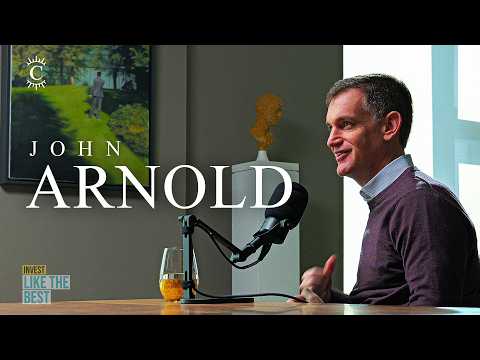
The World's Greatest Energy Trader on Markets, China, and AI
Patrick O'ShaughnessyJohn Arnold
China’s NIO built a robotic factory from shovel to first car in 17 months, with suppliers within 200 miles, highlighting a speed and supply-chain advantage over aging US plants.US energy demand is clear through 2030 but permitting is the bottleneck; delivered solar PPAs remain 50%+ above 2020 lows, while advanced geothermal is Arnold’s five-year call.
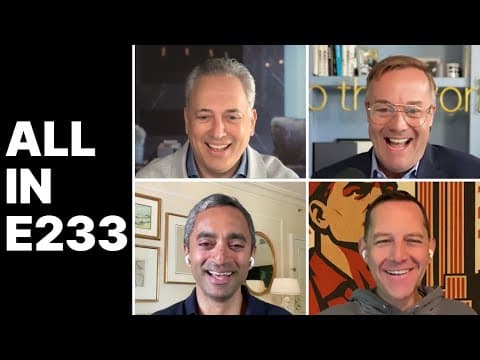
12 Day War, Socialism Wins in NYC, Stocks All-Time High, AI Copyright, Science Corner
Chamath PalihapitiyaJason CalacanisDavid SacksDavid Friedberg
Trump’s targeted strikes and ceasefire reduced the feared forever-war risk, while oil rising only from roughly $60 to $74 suggested markets priced a less chaotic Middle East.Mamdani’s New York upset exposed an indebted, “negative capital” generation, and the panel linked his urban-socialist platform to student debt growing from $500 billion to $2 trillion.Stocks reached all-time highs amid a split between weakening breadth and possible liquidity-driven upside, while early FOXO3 cell-therapy results and AI copyright rulings leave major scientific and legal risks unresolved.
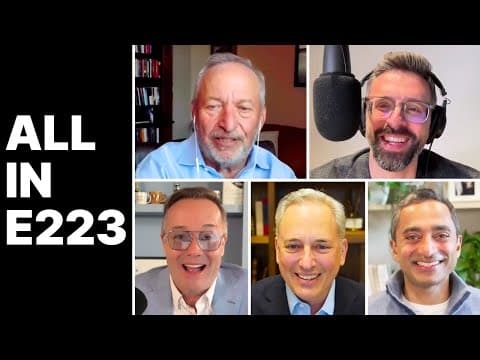
The Great Tariff Debate with David Sacks, Larry Summers, and Ezra Klein
David SacksLarry SummersEzra KleinChamath Palihapitiya
The 90-day retreat left a 10% universal tariff, sectoral duties, fresh threats, and a 125% China tariff, preserving policy risk rather than restoring the old trade regime.Summers estimated roughly $6 trillion in erased equity value and warned tariffs could weaken purchasing power, demand, and confidence, while the debate set a two-year test of growth, resilience, and trade outcomes.