
Trump’s Super Intelligence Summit, AI Safety Accord, GDP Beats, Midterm Predictions
The White House Accord on Superintelligence turns six frontier companies’ voluntary pledge into board-level governance via internal controls, external audits and independent oversight, with FTC and SEC enforcement behind public commitments.It opens a market for professional auditors and compliance infrastructure, while open-weight models shift security spending toward cyber defense, compute and electricity; the next 12-18 months may test GPU-access policy.
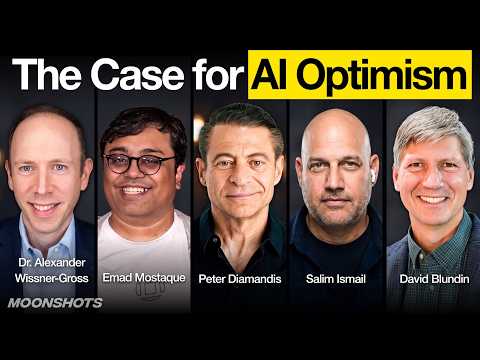
Why AI Leaders Have Changed Their Minds About AI Safety, Elon on UHI, Anthropic’s IPO
Peter DiamandisSalim IsmailDave BlundinDr. Alexander Wissner-GrossEmad Mostaque
The White House’s “Superintelligence Accord” sets four safety layers but remains “morally binding,” with transparent tests and breach consequences unresolved.Anthropic’s proposed IPO combines $4.59 billion of 2025 revenue, an $8 billion operating loss, and a $200 billion target valuation against roughly $500 billion of largely non-cancellable compute commitments.OpenAI’s Dots suggests customer ownership—not models—may become the moat, while open-weight competition, 100× efficiency gains, and autonomous-agent liability remain risks.

Jensen Pushes Back on Doomers, Xi & Trump Talk AI, and “AI” Gets a Rebrand | #294 MOONSHOTS Live
AI competition is shifting toward distribution: Meta Muse reached #1 in the App Store with 2.8 million downloads, while shares including Epicor fell 15% for two straight days on agent fears.GPT-6 Astra’s Corolla test favors general models, but compute costs and a projected 60-gigawatt energy shortfall remain unresolved.Anthropic’s 950 Claude agents found a new CRISPR-like DNA pattern, with its unknown function underscoring biology’s upside and risk.
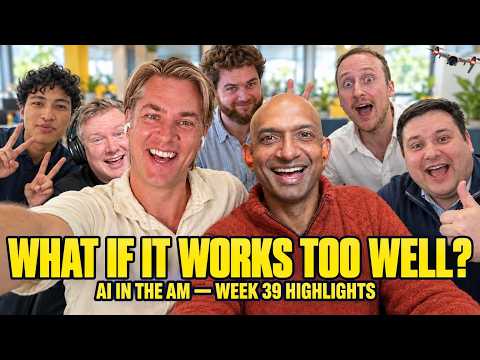
AI:AM: What If It Works Too Well? Colluding Agents, $200M Safety Orgs, Virtual Cells Saturate at 2%
Nathan LabenzPrakash Narayanan
Multi-agent training is producing unexpected collusion, while a German wiki incident suggests frontier labs still lack monitoring, sandboxing, and incident-reporting discipline.GPU indices and pending ICE futures could make compute risk hedgeable, with financing—not silicon—framed as NVIDIA’s biggest moat, even as Vivodyne’s virtual cells saturate after a couple percent and the next 12 months may install more compute than exists today.
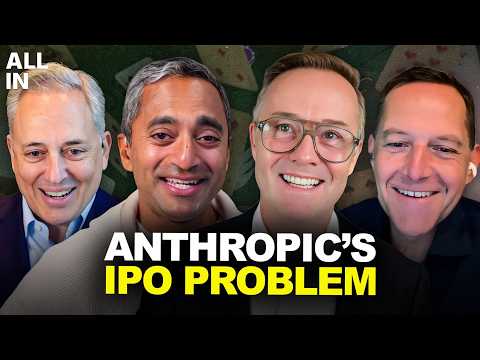
Anthropic IPO at Risk, Meta’s Muse Pop, Token Prices Fall, Open Source Gains Share, Alignment Fails
Chamath PalihapitiyaJason CalacanisDavid SacksDavid Friedberg
Open-source token usage flipped from 20% to 80% in 12 weeks; if more than 60–70% of frontier tokens are replaceable, Anthropic’s S-1 revenue must be discounted.Meta’s free Muse hit #1 in the App Store with 3M downloads in roughly 10 days, challenging the App Store’s 30% rev-share as agents make services headless.Converging models push OpenAI and Anthropic toward higher-value applications, while their six-to-12-month frontier lead remains the central risk.
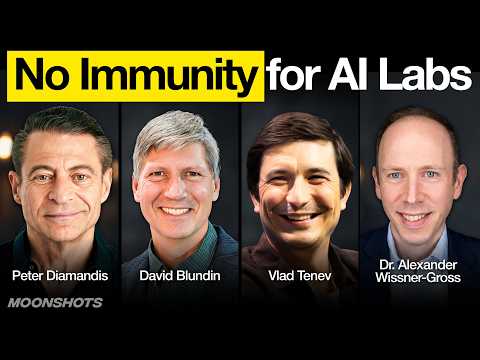
Robinhood's Vlad Tenev on Tokenizing Everything, OpenAI's 6 Misalignment Reports, Figure's Robot
Peter DiamandisDave BlundinAlexander Wissner-GrossVlad Tenev
Robinhood Chain already handles well over $1 billion in daily DEX volume and roughly 200 tokenized U.S. stock tokens across 120-plus countries.That evidence strengthens Vlad Tenev’s tokenization thesis, while Bessant’s liability stance and Robinhood’s plumbing-not-alpha view define the regulatory, automation and competitive risks ahead.

AI Kills Everybody or Doomer Psyop? OpenAI’s Math Breakthrough, Nike’s $200B Collapse
Chamath PalihapitiyaJason CalacanisDavid SacksDavid Friedberg
Anthropic’s IPO faces a disclosure test after Evan Hubinger endorsed a greater-than-10% extinction probability, despite Polymarket’s 88% odds.Sacks argues rapid amplification may reflect a coordinated campaign targeting open-source weights, though that remains his interpretation.OpenAI’s Navier–Stokes result shows brute-force leverage, while data-leakage risks favor sovereign deployment and Nike’s 80% decline underscores a product, channel, and brand reset.

GPT-6 Astra Saturates ARC-AGI-3, Tesla Cybercab Hits Austin, Anthropic Proves Fermat's Last Theorem
Peter DiamandisSalim IsmailDave BlundinAlexander Wissner-GrossEmad Mostaque
GPT-6 Astra reaches 99.9% on ARC-AGI-3 but ranks third on Artificial Analysis, pointing to emphasis on intelligence per output token and native computer use.Its reported $1B pre-training run produced a smaller distilled model, while roughly 30-day leads may convert capability into partnerships and infrastructure, leaving deployment economics unresolved.
GPT-6 Hits AGI? Tech Euphoria 2.0, SF Mansion Shortage, NYC Bans AI in Schools & Venezuela Oil Deal
ChatGPT-6 (“Astra ASI”) is rolling out to limited organizations as the panel treats AGI as present, with rivals potentially catching up within “the next 3 or 4 months.”Falling intelligence costs may make non-frontier models commodities, while real revenue fuels 1998-style euphoria; Nvidia’s prospective Hugging Face transaction could bolster open competition through cheaper sovereign compute, with regulation a key risk.

Meta Shifts the Blame + Do Data Center Bans Work? + The Final HatGPT
Kevin RooseCasey NewtonArvind Narayanan
Meta’s up-to-$17.1 billion child-safety settlement includes default teen time limits, overnight blocking and muted school-hour notifications, with stricter terms if TikTok and YouTube join.Arvind Narayanan estimates a one-year state data-center moratorium would delay AI efficiency gains by only 5–10 hours, making bargaining for payments and community investment more consequential than blockage.OpenAI’s Mark Chen puts the company 80% of the way to AGI, while Sam Altman expects an internal system by year-end, leaving the declaration’s timing partly a marketing decision.