PERSON DIRECTORY
Nikesh Arora
Nikesh Arora appears in 8 indexed conversations across All-In, 20VC, Hard Fork. This directory brings every appearance, source, TL;DR, digest, and transcript into one searchable feed.

Arvind Krishna & Nikesh Arora: Quantum Threat, Open vs Frontier AI, AI Cyber Warfare & SaaS Collapse
Krishna's 2028, 2029 or 2033 quantum timeline makes cryptographic migration a current spending decision: stolen encrypted data could be decrypted later.He expects open-weight models to capture 75%–90% of tokens, with optimized owned-GPU costs of $1–$2 per million versus $20–$50 externally.Enterprises may consolidate 500–5,000 software vendors into 5–10 platforms, but reliable transaction systems will be harder to replace.

Leo Aschenbrenner's Situational Awareness Blows Up | Moonshot AI Raises $3.5B at $35B
Airtable’s $1.285B sale at $485M of revenue and 20% growth signals a quiet capitulation among mature software companies, while Anthropic’s breaches point to a security spending supercycle as model-driven attacks compress response times.Inference demand remains strong across cloud and Palantir, but value may shift toward compute, land, permits, energy, and organizational context; Moonshot’s $35B financing makes model substitution a potential dislocation rather than demand destruction.

Nikesh Arora on the Frontier Model Problem: Breadth vs Depth | The Future of Token Costs
Frontier token prices may fall to one-tenth over 3–5 years as compute scarcity and loss-making consumer usage shift pressure onto enterprise coding.Memory could become the moat but model-embedded context risks captivity; enterprise AI still needs workflow redesign, while Mythos shows cyber risk is accelerating faster than defense automation.
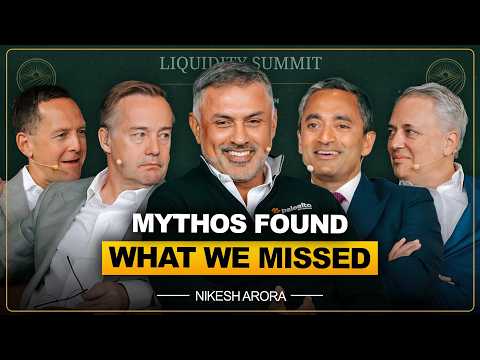
Palo Alto Networks CEO: "AI Found 5 Years of Bugs in 6 Weeks"
Chamath PalihapitiyaJason CalacanisDavid SacksDavid FriedbergNikesh Arora
Mythos found PANW vulnerabilities in six weeks that normally take five to seven years, for low millions, with comparable capability possibly three months away.Analytical SaaS faces direct substitution as customers query data through LLMs, while infrastructure, model-arbitrage applications, and hyperscaler distribution may capture value; false positives and hardware constraints remain risks.